
OEM Sanitary Ware & Drain Components (Series I)
1. Global Evolution of Stainless Steel Sink Strainers: Market Landscape (2025–2030)
The global plumbing fittings industry is undergoing a structural paradigm shift. Historically regarded as simple mechanical water-discharge hardware, the modern stainless steel sink strainer has evolved into a highly engineered fluid dynamics component critical to kitchen hygiene, waste management, environmental code compliance, and architectural aesthetics. As residential luxury kitchens, commercial food establishments, and industrial food processing hubs scale worldwide, demand for high-performance, corrosion-resistant drain infrastructure has surged.
Modern procurement strategies have shifted away from zinc-alloy and lower-grade brass castings toward premium austenitic stainless steel (primarily AISI 304 and AISI 316L). This shift is driven by rigorous lead-free regulations across North America (AB1953, NSF/ANSI 61/372) and Europe (EN 274), combined with consumer demand for scratch-resistant, non-porous surfaces that inhibit bacterial bio-film accumulation.
Material Metallurgy Shifts
Transitioning from traditional brass casting to deep-drawn SUS304 stainless steel eliminates dezincification risks while providing 3x higher tensile strength against aggressive acidic food residues.
Acoustic & Hydraulic Engineering
Integration of laser-micro-perforated baskets and under-flange acoustic dampening gaskets significantly reduces drainage vortex noise and speeds up water discharge rates.
Decorative Finish Innovation
Rising demand for physical vapor deposition (PVD) finishes—such as Matte Black, Brushed Gold, Gunmetal, and Rose Gold—enables seamless integration with luxury kitchen hardware trends.
2. Global Enterprise Procurement Demands & Intent Analysis
B2B buyers, global plumbing distributors, OEM sink fabricators, and big-box home improvement retailers possess highly specific, non-negotiable sourcing requirements when selecting a China Stainless Steel Sink Strainer Manufacturer & Factory. User intent analysis highlights four primary evaluation pillars:
1. Strict Code Compliance
Full compliance with ASME A112.18.2 / CSA B125.2 standards, UPC/cUPC certification, and NSF/ANSI 61 toxicity safety validations for seamless North American market access.
2. Thread Precision & Sealing
Machined 3.5-inch NPSM standard outlet threads and engineered silicone/EPDM sealing rings guarantee 100% zero-leak installations under extreme water pressure fluctuations.
3. Custom Branding & OEM
In-house laser engraving for distributor logos, custom retail packaging (color boxes, blister cards, barcoded cartons), and modular component customization.
4. Scalable Capacity & Lead Times
Automated production lines capable of manufacturing 500,000+ units monthly to ensure stable delivery timelines during global retail seasonal peaks.
Technical Sourcing Matrix: Material & Metallurgical Performance
Understanding the core material properties is critical for procurement managers optimizing product warranties and margin targets. Below is a comparative engineering benchmark:
| Material Grade | Chemical Composition | Salt Spray Resistance (NSS) | Tensile Strength (MPa) | Target Sourcing Application |
|---|---|---|---|---|
| AISI 304 Stainless Steel | 18% Cr / 8% Ni | 96 - 120 Hours | ≥ 520 | Residential & Commercial Kitchens (Global Gold Standard) |
| AISI 316L Stainless Steel | 16% Cr / 10% Ni / 2% Mo | 240+ Hours | ≥ 620 | Heavy Industrial, Marine & Coastal Architectural Plumbing |
| Solid Brass (C37700 / Lead-Free) | Cu 57-60%, Pb < 0.25% | 48 - 72 Hours | ≥ 380 | Classic Luxury Fitting, Traditional Plumbing Systems |
| AISI 201 Stainless Steel | 14-16% Cr / 1.5% Ni | 24 - 48 Hours | ≥ 310 | Budget Value Lines (Restricted to non-acidic environments) |
3. China Industry 4.0: Supply Chain Resilience & Manufacturing Superiority
As the global manufacturing index demands higher precision and faster iteration cycles, top-tier Chinese factories have evolved far beyond basic manual assembly. Modern China Stainless Steel Sink Strainer Manufacturers operate integrated Industry 4.0 smart facilities designed to deliver exceptional quality consistency and cost efficiency.
High-Speed Hydraulic Deep Drawing
Automated multi-station hydraulic presses form seamless strainer bodies with uniform wall thickness (±0.02mm tolerance), eliminating micro-fractures common in lower-tier cold-stamping processes.
Automated Robotic Polishing & PVD
6-axis robotic arms ensure 360-degree mirror polishing and consistent brushed metal graining. Closed-loop PVD vacuum chambers guarantee color batch consistency across millions of units.
AOI Vision Inspection & Testing
Automated Optical Inspection (AOI) systems perform 100% thread gauge checking, lip flatness laser scanning, and surface flaw detection prior to automated bagging and master boxing.
Dual-Base Production Strategy: Mitigating Geopolitical Risk
To ensure supply chain flexibility, industry leaders (such as JANA Plumbing) operate dual production footprints. By maintaining advanced manufacturing headquarters in Yuhuan, Zhejiang, alongside expanded overseas facilities (such as automated plants in Thailand), enterprise buyers gain strategic flexibility. This dual-base capability allows buyers to optimize tariff structures, safeguard sourcing logistics, and ensure uninterrupted order delivery during regional disruptions.
4. Application Scenarios & Specialized Engineering Models
Sink strainers are not one-size-fits-all. Different commercial, residential, and industrial environments demand tailored mechanical features:
Residential Kitchen Sinks
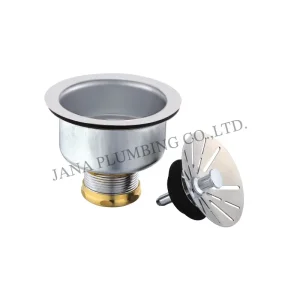
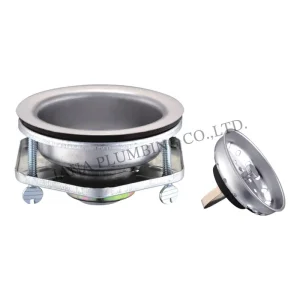
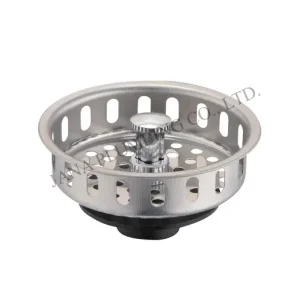
Focuses on aesthetic elegance, deep-cup basket capacities, ball-bearing positioning stoppers, and easy-clean removable strainer baskets for everyday domestic dishwashing.
Commercial Restaurants & Cafes
Demands extra-heavy gauge stainless steel bodies, extended thread lengths for thick solid-surface countertops, and high-GPM flow geometry to handle heavy kitchen turnover.
Food Processing Plants
Requires acid-resistant AISI 316L grade steel, integrated grease trap scrap interceptors, and lockable security grid tops to meet industrial environmental standards.
RV, Marine & Compact Housing
Requires shallow-cup depth designs (2" to 2.5" outlet configurations), anti-vibration locknut fittings, and lightweight corrosion-proof stainless alloys.
5. Quality Assurance Protocol & Quality Testing Standards
To maintain authoritative credibility and deliver long-lasting products, leading Chinese OEMs implement a rigorous 4-Stage Quality Control Protocol across all manufacturing lines:
IQC Material Testing
Spectrometric analysis of incoming raw stainless steel coils to verify exact Chromium and Nickel chemical ratios before stamping.
IPQC In-Line Checks
Real-time wall thickness measurement, thread pitch verification, and rim flanging angle tolerance inspection during production.
FQC Hydro & Surface Audit
100% pneumatic air-under-water pressure testing (0.6 MPa) to guarantee seal integrity, combined with salt-spray testing on finished batches.
OQC Packaging Audit
Barcode scanning, drop-test validation for retail master cartons, and custom shipping pallet shrink-wrap integrity checks.
Frequently Asked Questions (FAQ) for B2B Sourcing
Direct answers to essential queries raised by importers, distributors, and OEM buyers qualifying China factories.
OEM Sanitary Ware & Drain Components (Series II)
Partner with China's Premier Sanitary Ware Manufacturer
Looking for certified stainless steel sink strainers, lavatory drains, and engineered brass fittings? Connect with our engineering and B2B export team today for technical CAD drawings, custom OEM quotes, and compliance test documentation.