
Precision OEM Kitchen Sink Waste Strainers & Component Assemblies
Direct-from-factory architectural plumbing hardware certified to North American and European standard specifications.
Global Industrial Status & Macro Procurement Trends for Sink Waste Strainers
Analyzing global demand shifts, regulatory mandates, and supply chain dynamics driving the $4.8B commercial & residential plumbing trim sector.
The global market for kitchen sink waste strainers and underlying drainage assemblies has evolved from standard utilitarian fittings into highly engineered, compliance-driven components critical to modern building infrastructure. Driven by expanding residential construction across North America, stringent hygiene standards in commercial food service facilities across Western Europe, and rapid urban developments across the Asia-Pacific region, enterprise demand for heavy-duty, corrosion-resistant brass and stainless steel strainers continues an unprecedented upward trajectory.
Today's professional procurement ecosystem places paramount importance on structural integrity and mechanical longevity. Kitchen sink strainers are subject to harsh operational environments—exposed continuously to volatile temperature fluctuations, acidic organic food compounds, abrasive cleaning chemical agents, and significant mechanical impact. Consequently, low-tier die-cast zinc or thin-gauge stamped metal strainers are being systematically phased out by major distributors, building supply chains, and original equipment manufacturers (OEMs) in favor of deep-cup solid brass bodies, ball-bearing basket mechanisms, and high-tensile 304/316 stainless steel assemblies.
Code Compliance Mandates
International plumbing codes (UPC, cUPC, ASME A112.18.2 / CSA B125.2) dictate exact thread tolerances, seal endurance, and flow velocity requirements that mandate precision production engineering.
Material Metallurgy
Shift toward lead-free C37700 brass alloys and SUS304 stainless steel deep-drawing technology, providing superior chemical corrosion resistance against aggressive kitchen detergents.
Cost-per-Unit Optimization
High-volume automated production lines in specialized regional hubs enable competitive wholesale pricing structures while preserving tight dimensional tolerances within ±0.02mm.
Engineering Architecture & Metallurgical Specifications
Understanding the mechanical design, sealing dynamics, and physical alloy compositions behind high-performance waste strainers.
At the engineering level, a kitchen sink waste strainer functions as a dual-phase hydro-mechanical barrier. It must simultaneously maximize fluid discharge velocities (preventing water pooling in deep commercial sinks) while retaining particulate solid waste to safeguard municipal drainage networks. Achieving this balance requires precise hydraulic modeling, optimum perforation geometry, and robust mechanical sealing interfaces.
1. Solid Brass Forging vs. Stainless Steel Stamping
Engineers categorize premium waste strainers primarily by their structural body matrix:
- Heavy-Duty Brass Strainers (JN-1001 Series): Utilizes hot-forged C37700 brass billets machined on multi-axis CNC lathes. The heavy brass wall mass provides structural rigidity under extreme locknut tightening torque, ensuring the strainer body never distorts under heavy sink basin loading. Brass bodies are ideal for high-end residential installations and heavy commercial installations requiring electroplated finishes (Polished Chrome, Brushed Nickel, PVD Gold, Oil Rubbed Bronze).
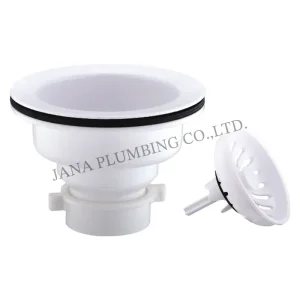
- Deep-Cup Stainless Steel / Polymer Assemblies (JN-1008 & JN-1206 Series): Features deep-drawn SUS304 stainless steel cups or high-impact engineered polypropylene bodies. Stainless steel offers extraordinary resistance to acidic foods and citrus juices, eliminating pitting corrosion over decades of service.
| Engineering Property | Solid Brass Body (JN-1001-1) | SUS304 Stainless Steel (JN-1005) | Engineered Polypropylene (JN-1008-3) |
|---|---|---|---|
| Tensile Strength | 440 MPa | 520 MPa | 35 MPa |
| Corrosion Resistance | High (Coated/Plated) | Exceptional (Native Passivation) | Complete Chemical Immunity |
| Thread Shear Force | Exceeds ASME A112.18.2 standard | High Precision Rolled Threads | Reinforced Molded Threads |
| Target Applications | Luxury Residential & Commercial | Heavy Commercial Kitchens & RVs | Economy Housing & DIY Retail |
| Lead-Free Certification | AB1953 / NSF 372 Certified | Naturally Lead-Free | Phthalate & Lead-Free |
2. Ball-Bearing Sealing Physics & Leak Prevention Mechanics
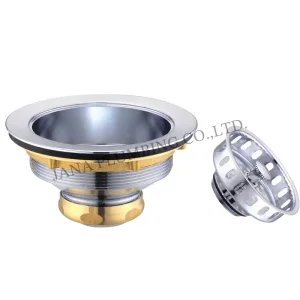
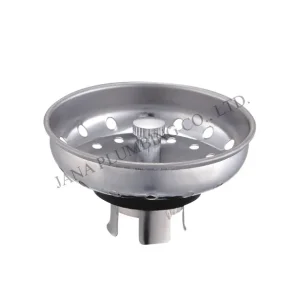
One of the primary failure points in lower-tier strainers is the stopper seating mechanism. JANA Plumbing integrates a ball-bearing positioning basket design (seen in model JN-1005). A spring-loaded stainless steel ball bearing engages with deep detention grooves along the central post rod, allowing users to effortlessly alternate between full drainage, secondary debris filtering, and a 100% airtight/watertight seal. Paired with extra-thick EPDM or silicone lip gaskets, the assembly guarantees zero fluid leakage under static head water pressure tests exceeding 0.6 MPa.
China Industrial Ecosystem Efficiency & Thailand Dual-Base Advantages
How JANA Plumbing's dual-manufacturing architecture mitigates geopolitical trade risks while offering unmatched cost-efficiency.
Global hardware procurement executives face dual challenges: securing ultra-competitive unit pricing while eliminating supply chain vulnerability caused by shifting geopolitical tariffs, trade barriers, and shipping bottlenecks. JANA Plumbing has solved this strategic equation through an integrated dual-production ecosystem across China and Thailand.
Yuhuan, China Headquarters
Operating since 1998 in Zhejiang Province—the world's premier brass plumbing manufacturing hub—our headquarters provides complete raw metal processing, rapid tooling, and custom engineering.
- Full in-house hydraulic forming & progressive stamping
- Tooling turnaround in under 72 hours
- Integrated electroplating & PVD surface treatment
Kabinburi, Thailand Base
Operational since December 2023, Gateway Enterprise Corporation (Thailand) spans 14,400 m² of state-of-the-art automated production capacity specifically designed for overseas trade exemption.
- Zero Section 301 tariff surcharges for US buyers
- Fully automated robotic CNC lathe lines
- Replicated quality management under ISO 9001
Unified Quality Assurance
Both manufacturing facilities operate under identical SOPs, utilizing advanced optical measurement inspection, spectrometer alloy testing, and 100% air-pressure leak testing prior to packaging.
- Traceable material heat number verification
- Unified UPC & cUPC certification coverage
- Consolidated logistics and multi-port container shipping
Localized Application Scenarios & Commercial Engineering
Tailored drainage solutions engineered for distinct regional standards and diverse installation environments.
North American Residential Sinks
Standard 3-1/2" diameter sink opening strainers engineered specifically for US/Canada composite granite, fireclay, and stainless steel undermount sinks. Compatible with standard 1-1/2" NPSM tailpieces and residential garbage disposers.
Commercial Kitchens & Hospitality
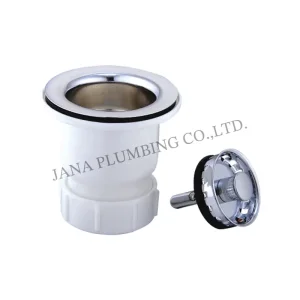
Heavy-duty deep duo basket strainers (JN-1206 series) designed for high-volume commercial prep sinks in restaurants, hotels, and food processing plants. Features extra-large solid brass locknuts and extended brass tailpieces for rigorous usage.
Bar Sinks & Compact Utility Areas
Junior duo bar sink strainers (2" to 2-1/2" opening dimensions) tailored for entertainment bars, RV sinks, and compact medical utility basins. Utilizes tray plug designs (JN-1203-T) for rapid fluid discharge and spaces with tight under-cabinet clearance.
Enterprise Sourcing Criteria & OEM Private-Label Framework
A structured approach for procurement directors, distributors, and brands seeking high-yield manufacturing partnerships.
When evaluating international plumbing hardware manufacturers, global enterprise sourcing teams must look beyond initial unit cost quotes. Ensuring long-term supply stability, zero field-failure rates, and brand protection requires evaluating manufacturers across four critical operational pillars:
1. Regulatory & Environmental Compliance Documentation
Failure to present validated listing documentation can result in severe customs holds or catastrophic distributor product recalls. JANA Plumbing maintains comprehensive compliance portfolios including:
- UPC & cUPC Certification: Listed through IAPMO R&T, ensuring full compliance with Uniform Plumbing Code standards across all 50 US States and Canadian provinces.
- AB1953 / NSF 372 Lead-Free Compliance: Verifying wetted surface lead content is under 0.25%, legal for potable water and residential kitchen sink applications.
- ISO 9001 Quality Management System: Audited factory workflow covering raw material spectrographic analysis, in-line process control, and pre-shipment lot sampling.
2. Tailored OEM / ODM Customization Capabilities
Private-label brands require exact visual and structural alignment with their existing product families. JANA Plumbing supports comprehensive custom branding services:
- Custom Surface Electroplating & PVD Finishes: Matching exact finish swatches for Chrome, Matte Black, Brushed Brass, Gunmetal Gray, and Venetian Bronze with 96-hour neutral salt spray (NSS) test verification.
- Laser Engraving & Brand Marking: Precision laser etching of distributor brand logos on strainer flanges, stoppers, or tailpieces.
- Contractor Packaging & Retail Packaging: Customized color boxes, skin-pack cards, polybags with barcodes, and master carton drop-test compliance for e-commerce and retail distribution channels.
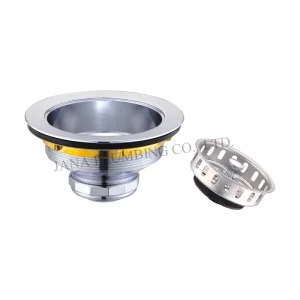
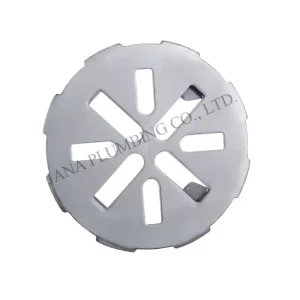
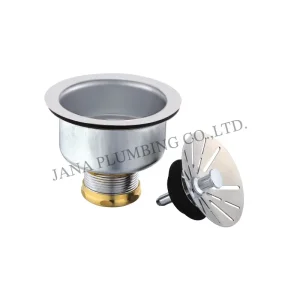
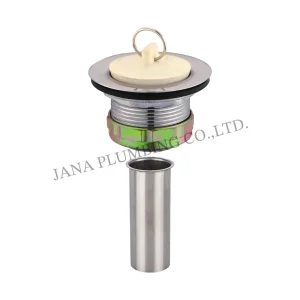
Complete Wholesale Kitchen Drain & Strainer Assemblies
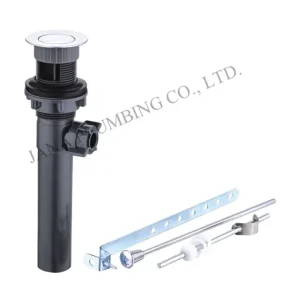
Explore our deep-cup, junior duo, snap-in grid, and pop-up replacement hardware engineered to exact trade specs.
Emerging Industry Trends & Next-Generation Drainage Innovations
Strategic analysis of technological shifts re-shaping kitchen sanitary ware over the next decade.
1. Toolless Fast-Lock Installation Systems
Contractor labor costs have escalated globally. Modern waste strainers are rapidly incorporating high-torque threaded lockrings or snap-lock undertray mechanisms that reduce installation time from 15 minutes down to under 2 minutes without requiring specialty plumber putty or basin wrenches.
2. Hydro-Dynamic Anti-Clogging Geometry
Advanced computational fluid dynamics (CFD) modeling allows engineers to design basket slot orientation and side-wall discharge ports that generate vortex fluid acceleration. This prevents organic sludge accumulation on the basket perimeter and minimizes odorous back-drafts.
3. Sustainable Eco-Brass & PVD Coatings
Environmental standards increasingly prohibit hexavalent chromium electroplating. Next-generation production utilizes zero-emission Physical Vapor Deposition (PVD) titanium plating and 100% recycled lead-free brass alloys (C36000 eco-brass) to align with circular economy metrics.
Wholesale Procurement Q&A for Kitchen Sink Strainers
In-depth answers addressing compliance, manufacturing capabilities, sample evaluations, and order logistics.
What materials are utilized in JANA Plumbing's heavy-duty kitchen sink strainers?
JANA Plumbing manufactures sink strainers using premium forged lead-free brass (C37700 alloy compliant with California AB1953), high-grade SUS304/SUS316 stainless steel, and heavy-duty engineered polypropylene (ABS/PP) for specialized deep-cup models. All rubber gaskets utilize high-grade EPDM or food-safe silicone to ensure decades of zero-leak service.
Which North American plumbing code certifications do your drain products hold?
Our kitchen sink strainers, lavatory drains, and bath/shower drainage lines hold official UPC and cUPC listings certified through IAPMO R&T. They are fully compliant with ASME A112.18.2 / CSA B125.2 standards, NSF/ANSI 61/372 lead-free requirements, and ISO 9001 quality management guidelines. Importers can request exact certificate listing numbers prior to placing POs.
How does ordering through your Thailand manufacturing facility benefit US buyers?
Our Kabinburi, Thailand manufacturing facility (Gateway Enterprise Corporation) provides US importers with a legal country-of-origin alternative that completely avoids Section 301 tariffs applied to Chinese-origin goods. Operating on 14,400 m² with identical automated machinery and ISO-certified QC protocols as our Zhejiang headquarters, it offers tariff relief without compromising quality or lead times.
Can JANA Plumbing produce custom OEM finishes and private-label packaging?
Yes. We offer complete OEM/ODM customization. We can electroplate or PVD coat strainers in Polished Chrome, Brushed Nickel, Matte Black, Oil Rubbed Bronze, and Brushed Brass. Furthermore, we provide laser engraving for your brand logo directly on the strainer flange and supply retail blister cards, color boxes, or bulk contractor packaging customized to your distribution specifications.
What is the standard production lead time and minimum order quantity (MOQ)?
Standard production lead time ranges from 30 to 45 days upon PO confirmation and sample sign-off. MOQ varies by SKU: standard brass sink strainers typically require 1,000 to 2,000 units per model, while specialized custom finishes or custom-molded polymer units may require higher initial production runs. Sample evaluation kits can be dispatched within 3 to 7 business days.
How do you ensure leak-proof performance and thread tolerance accuracy?
Every lot undergoes 100% pneumatic air-pressure testing under 0.6 MPa to confirm gasket seal integrity. Threads are cut on multi-axis CNC machines and verified using GO/NO-GO thread gauges to guarantee frictionless installation with standard 1-1/2" NPSM tailpieces and residential/commercial drain lines.